The Allison group develops and utilizes new light sources and techniques to follow the motions of electrons, holes, and nuclei in molecular and condensed matter systems on ultrafast time scales. Developing new technologies and physics ideas go hand in hand with gaining insight into ultrafast dynamics. Much of our work has focused on developing novel instrumentation and methods based on frequency comb techniques, enabling experiments that are difficult or impossible with conventional methods.
Frequency Combs
Frequency comb lasers, recognized with the 2005 Nobel prize in physics, have revolutionized atomic clocks and precision measurement. However, their enormous potential for ultrafast time-resolved measurements has been much less explored. The exquisite coherence of the pulse train of a frequency comb enables the signals from successive pulses to be coherently added and stored. This leads to orders of magnitude improvement in the attainable signal to noise of time-resolved experiments, enabling new and exciting directions that simultaneously push the boundaries of our ability to probe matter in the time and frequency domains. Now mature in the visible and near-infrared, research continues on new techniques for realizing high-power frequency comb light sources in more spectroscopically interesting regions of the electromagnetic spectrum. Mid-IR and THz combs enable the probing and excitation of vibrational modes, and other low-energy excitations such as magnons and plasmon-polaritons. UV combs enable the probing of electronic dynamics.
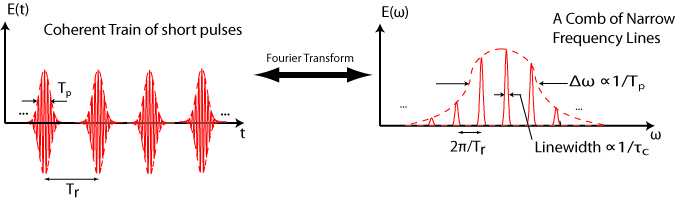
A frequency comb is formed by a train of well-controlled femtosecond pulses.
We have done substantial development of frequency comb light sources based on high-power fiber lasers. For example, a detailed “how-to” paper on Yb:fiber combs is here. Recent work has also developed high-power Er:fiber combs with few-cycle pulses, which can then be efficiently converted to the mid-IR and THz using intra-pulse difference frequency generation (DFG).
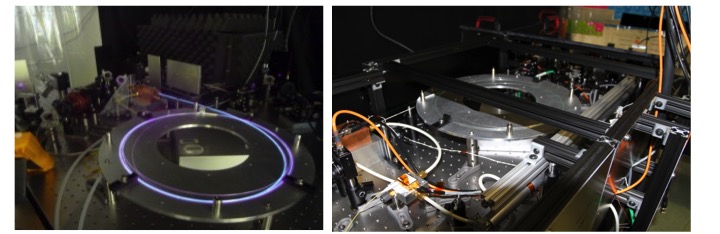
High-power Yb-doped fiber amplifiers in the Allison lab
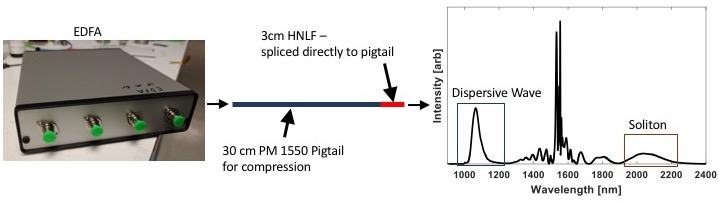
Left: A nonlinear Erbium-doped fiber amplifier, compactly fit into a small box. Right: Tunable frequency comb light spanning 1-2 microns. In this particular spectrum, the dispersive wave has been optimized for seeding our Yb-doped amplifiers.
In total, using a combination of fiber lasers, HNLF broadening, optical parametric oscillators (OPO) and amplifiers (OPA), and high-harmonic generation, we have now in the Allison lab frequency combs spanning seven octaves of frequency space, as illustrated in the figure below.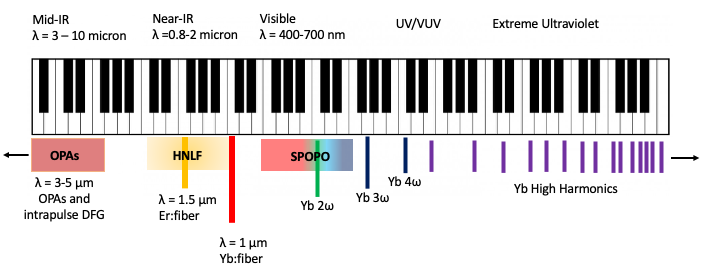
With major funding from the NSF and the development of a new 2500 square foot lab space in the Physics building, we are expanding this range to cover from the THz to the soft x-ray, or 17 octaves (about 2.5 pianos worth) of frequency space.
Electron and Exciton Dynamics in 2D Materials and Molecular Materials
Many current technological ambitions hinge on our ability to engineer and control the light-driven dynamics of energy, charge, and spin at the nanoscale. Prominent examples occur in the development of photovoltaics and photocatalysts, for the conversion of abundant sunlight into electrical power or chemical fuels, and the development of optoelectronics for information technology. The coherent manipulation of excited states also lies at the heart of emerging quantum information technology, in the context of quantum memories and quantum repeaters which work with photons as mobile qubits.
Recently, 2D Materials have emerged as an exciting platform for engineering light-matter interactions and producing devices with novel properties. For example the monolayer transition metal dichalcogenides (TMD, e.g. MoS2 , WSe2 , etc.), can have very strong light absorption reaching up to 10% for one monolayer, and also have unique chiral selection rules which allows one to create spin- and valley-polarized excitons with circularly polarized light. For another example, graphene possesses nearly constant absorption across the near-IR and visible, fast optical response, and very long spin diffusion length. Beyond monolayers, 2D materials can be assembled into nearly arbitrary combinations using van der Waals stacking, creating new hybrid materials with many opportunities for engineering new optical responses and materials with emergent properties due to strong correlations. Defect engineering provides yet another degree of freedom for control of these quantum materials.
Incorporating organic or organometallic molecules into the design of novel materials can also have several advantages for applications which are now being exploited by many researchers, such as strong optical absorption and efficient mechanisms for multiple exciton generation, including singlet fission. A recent trend in this field is to utilize the combination of thin molecular films and 2D materials, such as the transition metal dichalcogenides (TMDs), to have fine control of the electronic structure of both the molecular system and the inorganic semiconductor forming a heterostructure. Molecule/TMD heterostructures can, for example, combine the high optical absorption of molecular films with the high mobility of 2D materials. The combination of molecules with 2D materials also gives a large number of degrees of freedom to couple together to realize unique optical properties and emergent phenomena, including magnetic order, valley polarization, topological order, defects, crystalline order/disorder of the molecular film, molecular chirality, and moiré physics.
The underlying ultrafast nonequilibrium dynamics initiated by the absorption of light present major challenges to both theory and experiments. In our lab, we have developed unique instrumentation for imaging these dynamics directly in momentum space, as described in the next section.
tr-ARPES with High Sensitivity and μm Spatial Resolution
Ultrafast spectroscopy, in which femtosecond time-scale dynamics of nuclei and electrons are followed in real-time using short laser pulses, is now a long-established and mature field. Thousands of systems, in gas, liquid, solid, and plasma phases have been studied using ultrashort laser pulses and there are numerous textbooks on the subject. However, for all of this success, the central promise of ultrafast spectroscopy, to truly make a “movie” of electrons and nuclei moving on femtosecond time scales, has in many ways remained elusive. While “spectra” of absorbed or nonlinearly scattered photons, photoelectrons, or photoions are commonplace, turning this into a movie – a sequence of images – always requires significant interpretation.
Angle-resolved photoemission (ARPES) has long been the premier method for characterizing the quantum states of matter with crystalline order, and is often called the “gold standard” for electronic structure determination. From a clean surface, the photoemission process preserves an electron’s momentum parallel to the surface k∥ , such that measuring the angle a photoelectron is emitted from the surface and its kinetic energy directly reports on the electron’s energy and momentum in the solid. More formally, ARPES measurements give the one-particle spectral function, which reduces to the band structure ε(k) in the absence of strong interactions. The photoelectron’s spin can also be measured (sr-ARPES), giving a direct unambiguous measurement of all the quantum numbers for an electron moving in a material with periodic order (e.g. quantum materials, ordered molecular films).
The extension of ARPES and sr-ARPES to the time domain using pump/probe methods with ultrashort pulses then seems a quite natural and obvious way to address the ultrafast spectroscopy interpretation problem: To understand non-trivial excited states or complicated dynamics initiated by optical excitation, to truly make an ultrafast “movie,” use the gold standard observable. However, the implementation of time-resolved ARPES (tr-ARPES) has always been very challenging. There are many ancillary technical problems (e.g. space charge, photon energy tuning, etc.) but the fundamental issue at the root of all difficulties is data rate. Adding pump pulses to the ARPES experiment adds 4 dimensions to the data set, namely pump-probe delay, pump wavelength, pump fluence, and pump polarization. Furthermore, the signal size in an excited-state ARPES measurement is inherently much smaller than in ground-state measurements performed at synchrotrons, since only a fraction of the sample’s electrons are excited by the pump pulse. Thus, while tr-ARPES measurements using XUV light (which is necessary for covering the full Brillouin zone) have been performed for some time now, they have been severely limited in the phenomena they are applicable to. In particular, it has been very difficult to perform experiments with very weak pump excitation, where changes to the photoelectron spectrum are small, and this is the regime that is actually relevant to the motion of electrons, excitons, holes, etc. in real-world devices!
Over the past 10+ years, we have in the Allison group developed a unique beamline to address this grand challenge. Our setup is shown in the figure below. We generate ultrashort XUV pulses with tunable photon energy at 61 MHz repetition rate using the technique of cavity-enhanced high-harmonic generation (CE-HHG), in which we resonantly enhanced a frequency comb laser to roughly 10 kW circulating average power in a resonant cavity. XUV light generated in the cavity is guided by a series of grazing incidence optics to an ultra-high vacuum ARPES endstation. Photoelectrons are detected using time-of-flight momentum microscopy (ToF k-mic), which collects the full 2𝜋 solid angle of photoemitted electrons in parallel. This combination of high repetition rate XUV pulses and full 2𝜋 photoelectron detection more or less maximizes the data rate, and thus the sensitivity, of tr-ARPES measurements, advancing the state of the art by several orders of magnitude and enabling measurements in a qualitatively new regime. We have recently written a perspective article discussing the technical details and highlighting this paradigm shift in the field.

The Stony Brook tr-ARPES Beamline. A high-power frequency is resonantly enhanced in high-finesse cavity to produced high harmonics (10-40 eV) at 61 MHz. A single harmonic is selected for photoemission using a pulse-preserving monochromator. Photoelectrons are analyzed with a time-of-flight momentum microscope.
In addition to massively parallel detection, the ToF k-mic also enables us to perform tr-ARPES measurements on micron-sized samples. This dramatically opens up the space of materials we can study with tr-ARPES. The figure below show an example of both real-space imaging (PEEM) and band-mapping of a small exfoliated flake of monolayer WS2. In addition to working with 2D materials and 2D materials and devices, this micro-ARPES capability allows us to work on samples with small domains.
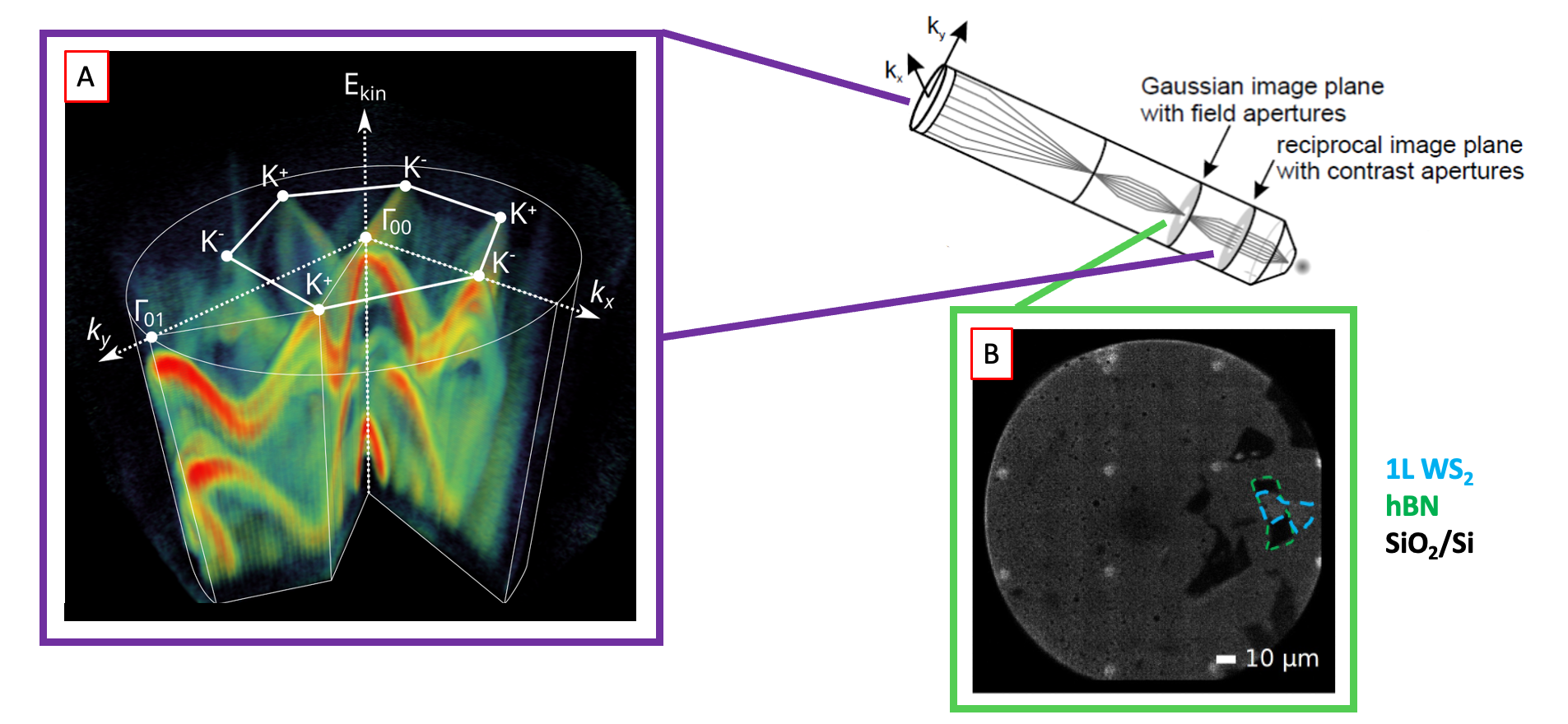
A. Full valence band structure for monolayer tungsten disulfide (WS2) measured from a 10 micron exfoliated flake in seconds using the parallel detection of the momentum microscope. B. Real-space PEEM image of the sample.
Ultrafast electron dynamics are imaged directly in momentum space using the pump/probe method. An example movie (raw data!) of electron dynamics in a bulk WS2 sample is shown in the figure below. Electrons are first excited at the K points at the Brillouin zone edge and then scatter into the lower-energy Λ valleys. Also visible are the Λ valleys of the second Brillouin zone, illustrating the wide momentum coverage of our system.
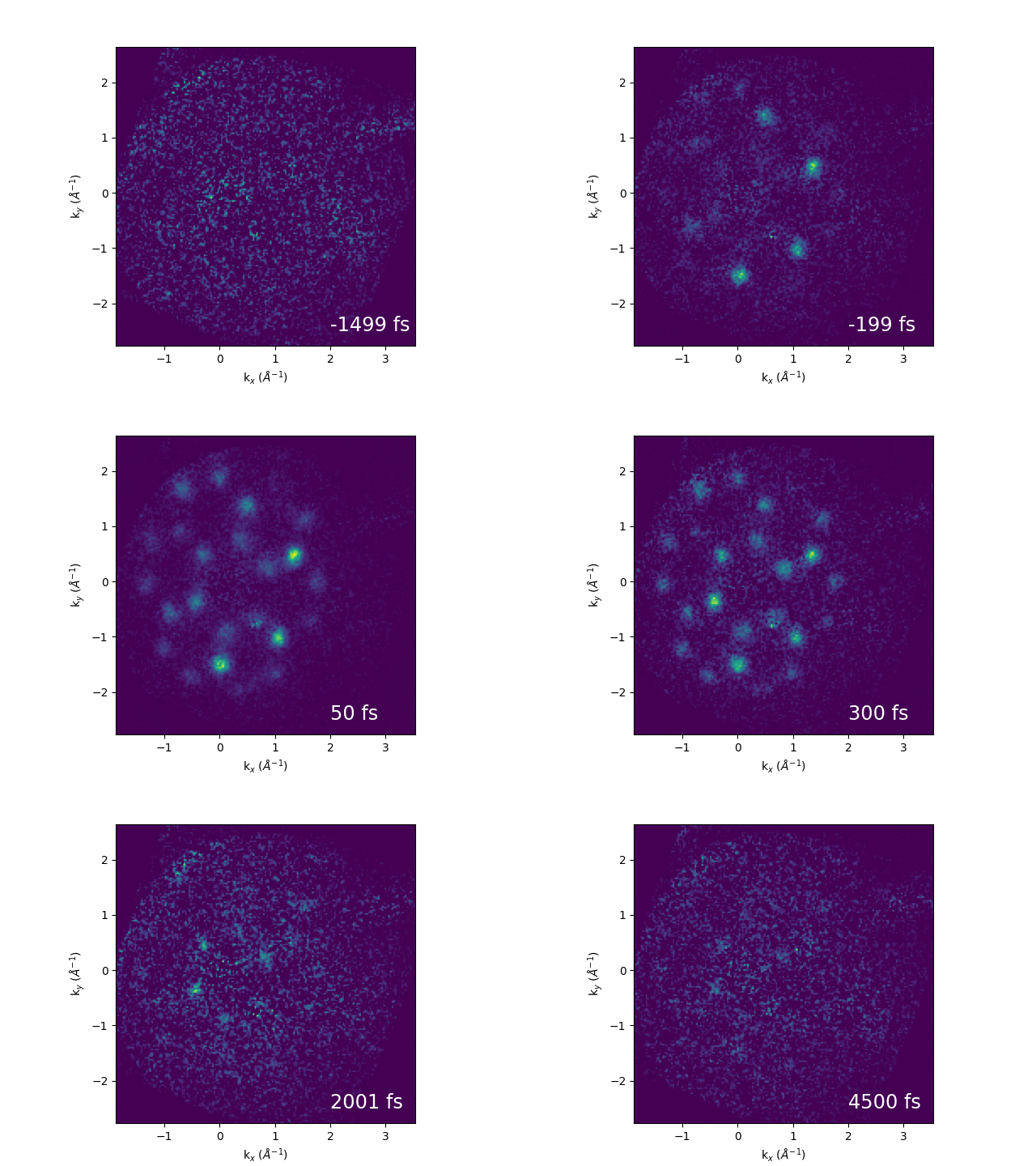

Ultrafast electron dynamics in bulk WS2 after optical excitation with 517 nm light. Electrons are first excited across the direct bandgap at K, and then scatter to the conduction band minimum at Λ.
Ultrasensitive all-Optical Ultrafast Spectroscopy
Most ultrafast spectroscopy measurements involve detecting the absorption or emission of light. However, these all-optical methods are then typically restricted to optically thick samples such as solids or liquids. In the Allison lab, we have pioneered new techniques using frequency combs to improve the sensitivity of all-optical ultrafast spectroscopy by nearly four orders of magnitude. The basic ideas of cavity-enhanced ultrafast spectroscopy are illustrated in the figure below.
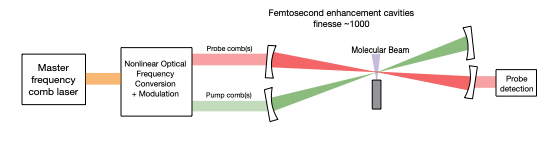
The basic principle of cavity-enhanced ultrafast spectroscopy. Pump and probe combs are both resonantly enhanced in optical cavities. The nonlinear spectroscopy signal is enhanced by a factor proportional to the cavity finesse squared, enabling large signal enhancements even for cavities of modest finesse.
After an initial demonstration experiment in 2016, substantial effort has gone into the development of a broadband spectrometer covering nearly the entire visible spectral range, shown below. We have applied this spectrometer to a series of experiments on gas-phase molecules undergoing tautomerization reactions and compared our results to theoretical calculations with collaborators. In addition to the specific molecular dynamics details of the chosen molecules, this work has broader implications in the interpretation of ultrafast spectroscopy observables in general.
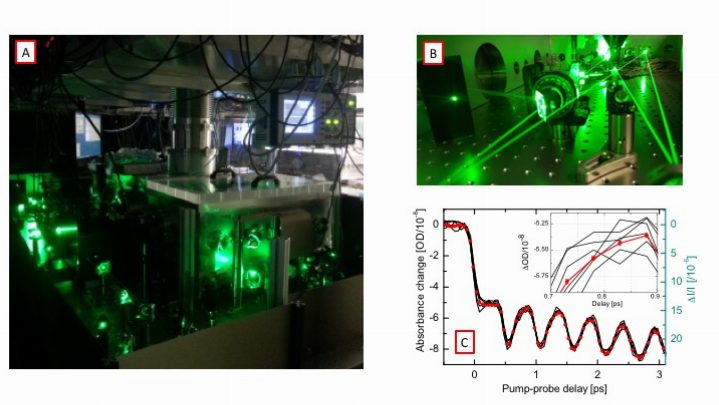
A and B: The cavity-enhanced ultrafast spectrometer. Two femtosecond enhancement cavities are built on a vibration isolated platform inside the vacuum chamber. C: Transient absorption data recorded form molecular iodine with a noise level of ΔOD = 2E-10.
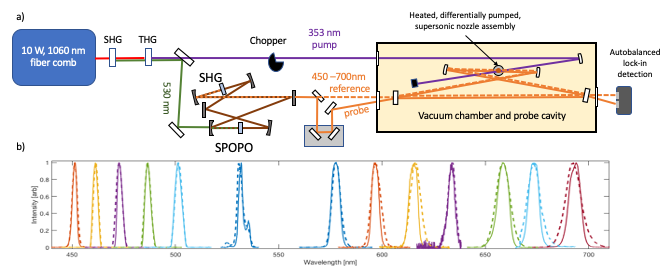
a) The tunable UV/VIS CE-TAS Spectrometer. Tunable combs from a synchronously pumped optical parametric oscillator (SPOPO) are resonantly enhanced in a 4-mirror dispersion-managed ring cavity. b) Intracavity spectra (solid) and spectra incident on the cavity (dashed). The intracavity GDD is low enough that bandwidth reduction due to the cavity is minimal.Future work is planned for the development of cavity-enhanced ultrafast spectrometers operating in the infrared for recording 2DIR spectra of dilute gasses. This has applications in both basic science (e.g. ultrafast 2DIR of hydrogen-bonded clusters) as well as major real-world applications in trace-gas analysis.
Rotationally-Resolved 2DIR Spectroscopy
The sensitivities we achieve with our cavity-enhanced ultrafast spectrometer, in terms of minimum workable molecular column densities, are comparable to or better than many commercially available cavity ringdown spectrometers for trace gas analysis. A nonlinear spectroscopy for trace gas analysis can be highly desirable since this can be used to better decipher complex mixtures in which many molecules have overlapping (linear) spectra. With this motivation, we have studied the feasibility of applying the ultrasensitive nonlinear spectroscopy techniques we have developed to the problem of trace gas analysis. The main idea is to record cavity-enhanced 2DIR spectra using multiple combs and cavity enhancement, as we first described in 2016. Experiments in gasses can be performed with rotational-state resolution, with sensitivities below 1 ppb attainable even in the presence of large background. However, when we started this project there was very little worm on 2DIR spectroscopy in gasses, with only a handful of results on linear molecules and only in very specific situations. We developed new comprehensive theory to calculate rotationally-resolved 2DIR spectra under a range of conditions. With this work, we discovered several new polarization conditions unique to gas-phase 2D spectroscopy that enable remarkable control of the spectrum and discovered a new polarization angle condition (analogous to the well-known “magic” angle) which simplifies the complex patterns observed in rotationally-resolved 2DIR considerably. We have called this new angle the population-alignment cancelling angle, θPAC = sin−1(2/√7) = 49.11 degrees. We expect polarization control of rotationally-resolved 2D spectra to be extremely helpful for background suppression and isolating the spectra of specific molecules in complex mixtures. We have published two papers on this subject, a comprehensive theoretical framework, and a shorter letter highlighting the polarization control of rotationally-resolved 2DIR spectra. We have also published software that simulates the full 2DIR spectra.
Future work will pursue the experimental realization of cavity-enhanced 2DIR spectrometers for multi-species trace gas analysis.